808 Patterns That Knock: Writing and Gluing Your Low End
An 808 pattern that knocks comes down to three skills. Placement: start the 808 glued to the kick on the same steps. Pitch: tune it to your key and write the line like a bassline in a piano roll. Glue: soft clipping, so kick and 808 fuse into one dense hit that survives any speaker.
The 808 is the center of gravity in modern beats, and the most misunderstood sound in them, because it looks like a drum and behaves like a bassline. Treat it like a kick (one note, one pitch, fire and forget) and you get the classic beginner low end: fine in headphones, invisible in the car, mud in the club.
Writing 808s that knock is really three separate skills (placement, pitch, and glue) plus one signature move, the glide. None of them is hard once you see what an 808 actually is: a sustained, tuned note that happens to start with a thump.
Why a drum machine kick became the bassline
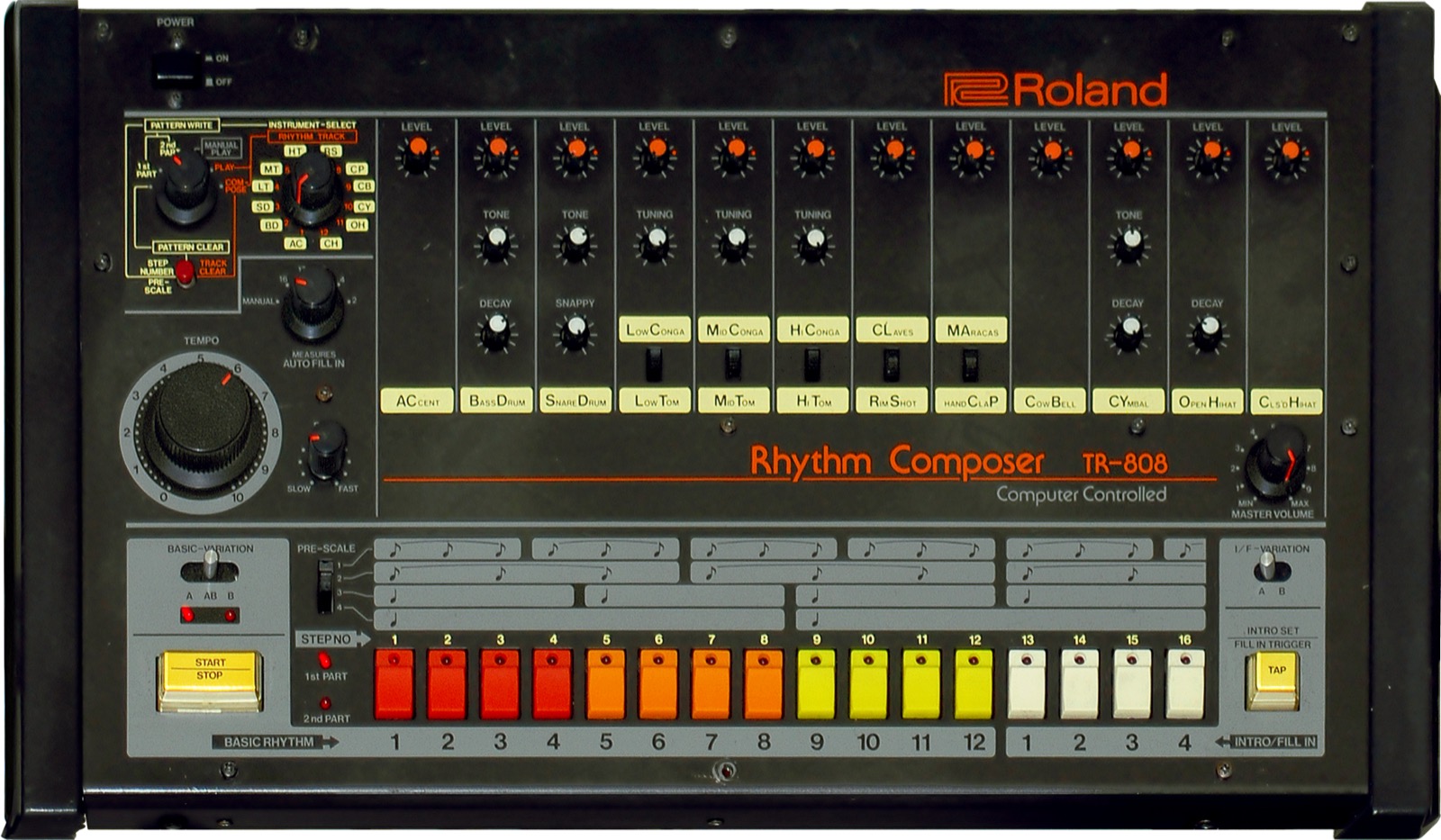
The name comes from one machine: the Roland TR-808, built from 1980 to 1983 and a commercial failure in its day, roughly 12,000 units sold. Its synthesized bass drum had a decay control that could stretch the kick into a long, sinking boom, and producers realized a kick with a decay that long isn't a kick anymore: it's a bass note. Tune it and sequence it, and the drum machine is suddenly playing the bassline. That trick, which Rick Rubin helped popularize, became the foundation of hip-hop low end, and "808" became the word for any deep sustained bass hit, long after most of them stopped coming from the machine itself.
Placement: start glued to the kick
The reliable starting point is to program the 808 and the kick on the same steps, so the kick's attack and the 808's body land as one drum:
That's the standard trap placement (downbeat, the last 16th of beat 2, the "and" of beat 3), and locked together like this, the kick supplies the transient while the 808 supplies everything after it. That division of labor is why the pairing works on every system: small speakers get the punch, big ones get the weight.
Once the pattern sits, let the two lanes diverge. That's where 808 lines get personality:
- The 808 holds; the kick repeats. Give the 808 fewer, longer notes and let the kick punch over the sustain.
- The 808 adds pickups the kick skips: a short note on a late 16th that drags the ear into the next downbeat.
- The kick keeps time; the 808 keeps melody. Once pitch enters the picture, the 808 can walk between notes while the kick stays planted.
Pitch: an 808 line is a bassline
An 808 has a pitch, which means an 808 pattern is a melodic part whether you meant it to be or not. Two rules cover most beats.
Tune it to the key. The root note of your track is the 808's home base. An untuned 808 fights the melody in the least fixable register of the mix: nothing above it can EQ the clash away.
Write the line in the piano roll. The step grid answers when; pitch is a what. In TrapMan every lane opens into its own piano roll, so the 808 lane is where the grid pattern becomes actual notes: root on the strong hits, a walk up to the fifth, an octave drop (Cmd+Shift+Down) for the section change. Keep it simple: two or three pitches per loop is plenty when every note fills the entire floor of the mix.
Glide: the slide that sells the line
The signature 808 move is the slide: instead of jumping cleanly from one pitch to the next, the note glides between them, a smooth pitch ramp, like a bass player sliding a finger up the neck.
How you get the ramp depends on what's playing the 808 (portamento on a mono synth, note overlap in some samplers, pitch automation as the universal fallback), but the concept is identical everywhere: the second note starts at the first note's pitch and travels. Slides read best on bigger intervals (a third or more), at phrase boundaries, and sparingly. The slide is the hook of the bassline, not its metronome.
Glue: making it knock on every system
"Knock" is the feeling of kick and 808 arriving as one dense event, and the classic way to get it is saturation: specifically soft clipping, which rounds off the transient peaks so the whole low end can sit louder, and adds a little harmonic weight on top. Those extra harmonics matter more than they sound like they should: they're what a phone speaker reproduces when it can't play the fundamental, so a clipped 808 stays audible on the worst system your beat will ever meet.
In TrapMan that's one click: Slap, the built-in soft clipper. Loop the pattern, toggle it, A/B: off is polite, on is dense. Kick and 808 first; that's where it earns its keep.
Two more glue rules, free of charge. One 808 at a time. Overlapping tails turn the floor to mud, so when a new note starts, the old one should end. And leave space around the hits: the 808 knocks hardest against silence, which is why the classic trap patterns keep so much air around the low end.
FAQ
Why does my 808 disappear on small speakers?
Small speakers can't reproduce the fundamental: much of an 808's energy sits roughly around 30–60 Hz. What survives is the harmonics, so an 808 with none (a pure, clean sub tone) simply vanishes. Saturation or soft clipping adds those harmonics back; that's a big part of why gluing with Slap keeps the 808 audible on a phone.
Should the 808 and kick hit at exactly the same time?
When they share a step, yes: that's the point of starting glued. As the line develops it's fine, good even, for the 808 to take hits the kick doesn't have and vice versa. What matters is that simultaneous hits actually start together instead of flamming a 16th apart by accident.
What notes should an 808 line play?
The root of your key on the strong hits, with movement borrowed from the scale: the fifth and the octave cover most trap basslines. Two or three pitches per loop is typical; the 808 register punishes busy lines. And tune the 808 sample itself first, so the piano roll notes mean what they say.
How long should 808 notes be?
As long as the space allows and no longer: sustain until the next 808 or kick event, then hand off cleanly. Tails that overlap the next note are the most common source of muddy low end. In the piano roll, drag each note's length so the line breathes instead of smearing.