Trap Drum Patterns 101: From First 808 to a Finished Beat
A trap drum pattern runs around 140 BPM with a half-time feel: the kick and 808 ride beat 1 with an off-beat bounce, a single snare cracks on beat 3, and hi-hats stitch the space together in double- and triple-time. Three or four sounds placed with intent: that's the genre's entire skeleton.
Trap drums are a lesson in space. The project tempo says fast (around 140 BPM), but the feel is slow motion: an 808 so deep it doubles as the bassline, a snare that makes you wait until beat 3, and hi-hats stitching the emptiness together in double- and triple-time. Every hit has room to land, and that room is why the 808 hits the way it does.
That space is also what beginners get wrong. Hear trap, add more (more kicks, more layers, more fills) and the beat gets smaller with every addition. A trap pattern that knocks is usually three or four sounds placed with intent, and on a step grid those placements are something you can see.
So that's the plan: one paragraph of history, three grids you can copy cell for cell, the sounds to put on each lane, and the techniques (rolls, ghosts, swing, halftime) that turn a pattern into a beat.
One paragraph of history
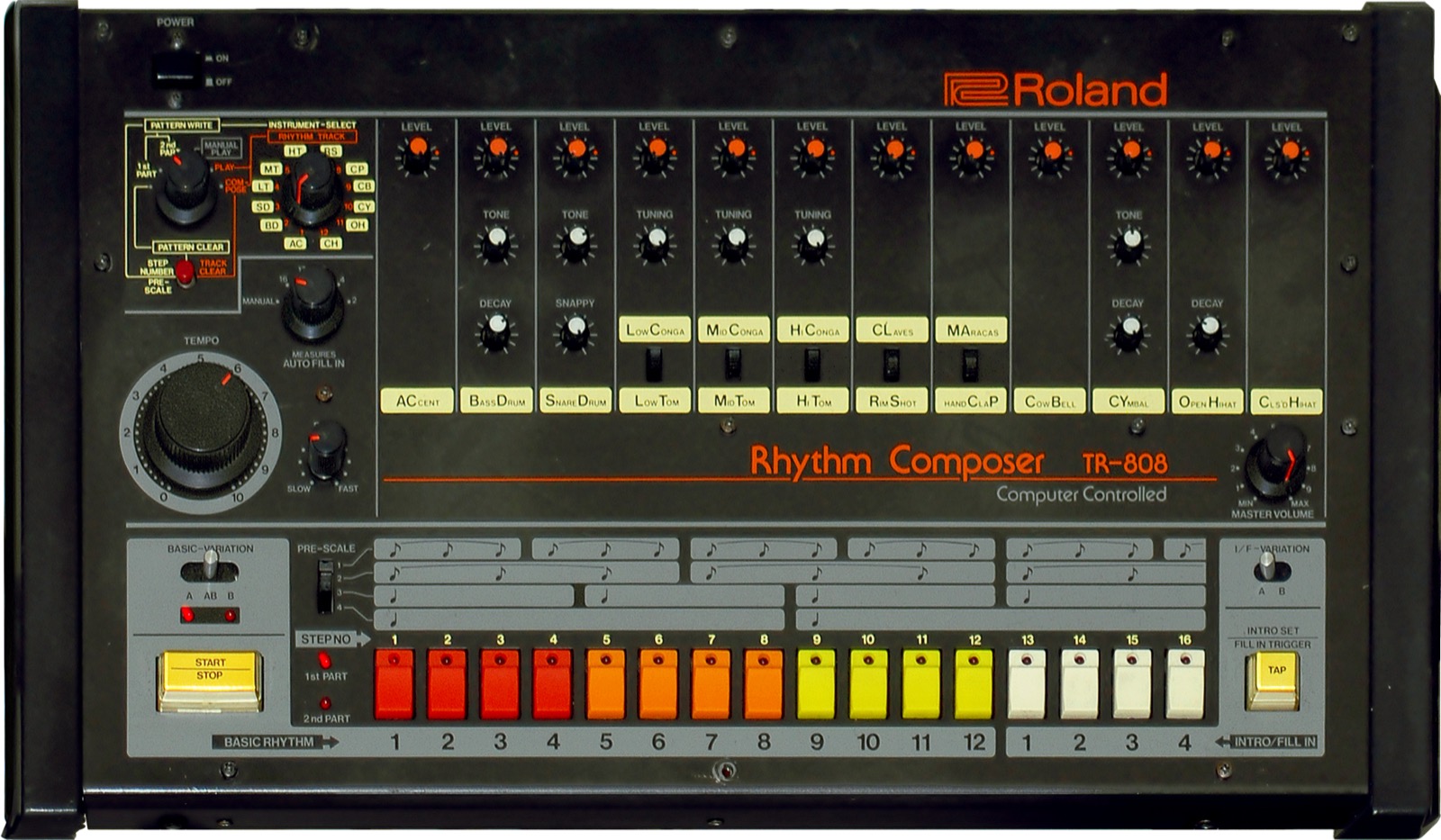
Trap grew up in the American South. The name is Atlanta slang (a "trap house" is a drug house), and the sound formed there through the 1990s: lyrical references to the trap show up as early as 1991, the modern production style is usually dated to 1999, and rappers like T.I., Jeezy and Gucci Mane carried it to the mainstream over beats from producers such as Shawty Redd and Zaytoven, with Lex Luger's 2010 run for Waka Flocka Flame hardening the template most trap still follows. Under all of it sits one machine: the Roland TR-808, built from 1980 to 1983, a commercial flop that turned up cheap secondhand, often under $100 by 1983, and went on to appear on more hits than any drum machine before or since. Its synthesized kick is why we call the bass an "808" in the first place.
The starter pattern
Set the grid to one bar of 16th notes and think half-time: kick and 808 own beat 1, the snare cracks once on beat 3, and eighth-note hats keep the clock. Here's the shape:
Read it like a producer. The kick fires the downbeat, sneaks back in on the last 16th of beat 2, then bounces on the "and" of beat 3, right behind the snare: that stumble is the bounce. The snare's single hit on step 9 is what makes 140 feel like 70. And the hats are deliberately plain, because they're about to stop being plain.
Program the kick lane and the 808 lane on the same steps at first, so the attack and the sub move as one drum. Once the pattern sits, the 808 earns its own line (more on that below).
The hats are the lead instrument
Strip the melody out of most trap beats and they still read as trap, because the hats carry the identity: steady 16ths that dissolve into rolls. Here's one bar at 32-step resolution: every other cell is a 16th note, so the accents (X) pin the first three beats, and the last eight cells are a 32nd-note roll swelling into the next bar:
Nobody wants to click in eight 32nd notes by hand. In TrapMan the roll is one keystroke: select a hat note in the lane's piano roll and hit Cmd+U to subdivide it by the current grid. Set a finer grid and hit it again for a faster stutter. If Logic is home for you, the full comparison with Note Repeat and Step Sequencer ratchets lives in hi-hat rolls in Logic Pro.
The fuller groove
One percussion element answering on the off-beats is usually all the "more" a trap pattern needs:
The perc row (a rim, a bell, a blip) lands on the "and" of every beat, exactly between the hats' strong hits. It fills the bar without crowding it, which is the whole trick of trap arrangement. If the groove still feels empty after this, the fix is movement: velocity, a roll, an 808 line, not another drum.
What to reach for
Lane by lane, out of the six families in the TrapMan Core Kit (808s, kicks, hi-hats, snares, claps and percussion):
- 808 first. It's the foundation and half the melody. Pick it before anything else and tune it to your key.
- Kick: short and punchy, chosen against the 808: the kick supplies the attack, the 808 supplies the body.
- Hats: a tight closed hat that stays clean when subdivided. Audition it with a roll playing, not a single hit.
- Snare: the crack on 3. Layer a clap on a second lane for width, or let the clap carry the backbeat alone.
- Perc: anything with personality. This is the lane that makes the loop yours.
Make it move
Four techniques carry most finished trap beats:
Velocity. Accent the hats on the beat, ghost the ones in between, and a machine-gun tick turns into a groove. The velocity lane under each piano roll is where flat patterns go to get fixed.
Swing. Trap is mostly straight, but a small late drag on the off-beat hats humanizes the ride: set a finer grid and nudge them late with Cmd+Arrows.
The halftime flip. Slow, TrapMan's built-in halftime effect, drops the whole pattern into pitched-down half speed, a one-click switch-up for a bridge or outro.
Knock. Slap, the built-in soft clipper, is the difference between polite drums and drums that push air. Kick and 808 first; that's where it earns its keep.
When the pattern is done, getting it into your session is a drag: MIDI keyswitch clip or bounced audio. The full Logic walkthrough is in how to make trap beats in Logic Pro, and the same moves apply in any DAW.
FAQ
What BPM should trap drum patterns be?
Around 140 BPM with a half-time feel is the classic center: snare on beat 3, not on 2 and 4. Counted in double-time the genre runs from roughly 100 to 176 BPM, so trust the feel over the number: if the snare drags, the tempo is wrong.
Should the kick and the 808 play the same pattern?
Start that way: program both lanes on the same steps so the attack and the sub land together. Then let them diverge: keep the kick pattern steady and write the 808 line in its lane's piano roll, where it can hold longer notes, walk between pitches and skip hits the kick keeps.
How many hat rolls per bar is too many?
If every bar rolls, no bar rolls. A common shape is one roll every two or four bars, landing into beat 3 or into the next downbeat: the roll is punctuation, not the sentence. Vary the subdivision (16ths, 32nds, triplets) more than the frequency.
Why does my trap beat sound empty instead of spacious?
Usually one of three things: the 808 isn't sustaining between hits (check its tail), everything sits at one velocity (so the silence has no motion around it), or there's no off-beat answer like the perc row above. Space works when something small keeps pulling the ear across it.