Maschine vs Plugin Step Sequencers: Need the Hardware?
Maschine is an integrated hardware-plus-software production system (pads, screens and the NI ecosystem), and it pays off when you actually play the pads. A plugin step sequencer covers the grid-first workflow inside your DAW for a fraction of the cost. The deciding question: do your beats come from your hands, or your mouse?
Ask the internet how to make your drums faster and you'll get two confident answers. "Get a Maschine": pads, screens, the full Native Instruments ecosystem. "Just get a plugin": a fraction of the cost, nothing on the desk. Both answers are right. They're just right for different producers, and buying the wrong one is how studios end up with beautiful hardware that mostly holds a coffee cup.
Full disclosure before the comparison: we make TrapMan, a plugin step sequencer, so we're one of the two answers. Which is exactly why this piece starts by being fair to the other one, because Maschine is genuinely great at what it's for, and the only question that matters is whether what it's for is you.
What Maschine actually is
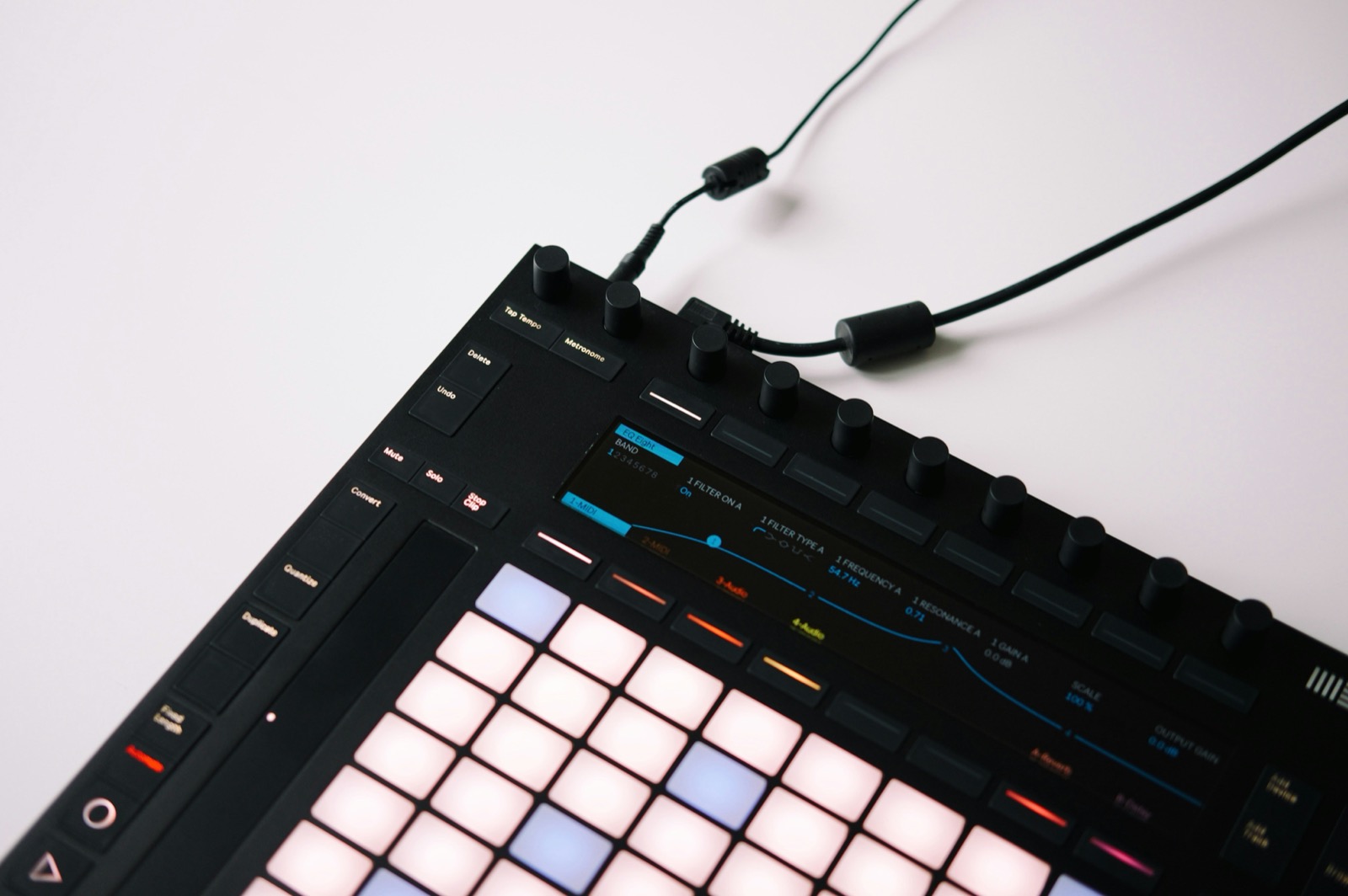
Maschine is not "a pad controller." That undersells it badly. It's Native Instruments' integrated hardware-plus-software production system: a controller with velocity-sensitive multi-color pads and color displays, married to software that's a sampler, arranger, mixer and FX rack with a bundled sound library. The flagship unit even carries a built-in audio interface. You can run the system with a computer, load it as a plugin inside Logic, Ableton, FL or your DAW of choice, or go computerless entirely with Maschine+, the unit that needs no laptop at all. The hardware and software were designed for each other, and it shows: the integration is the product.
Who genuinely benefits
Be honest with yourself about four profiles, because Maschine is a real upgrade for all of them. Finger drummers: if your beats come out of your hands (velocity, flams, feel), pads are an instrument, and Maschine's are excellent. Performers: Maschine+ on a stand needs no laptop, which changes what a live set can be. Screen-fatigued producers: some people genuinely work better with hands on hardware and eyes off the mouse; for them the ecosystem is liberation, not lock-in. All-in-one seekers: if you want one company's sampler, sounds, effects and workflow as a coherent world, NI built exactly that.
If you read those four and felt seen, stop reading and go try one in a shop. Sincerely.
The honest costs
Now the other column. Maschine is a hardware purchase plus an ecosystem (check current pricing, but it's several multiples of a typical drum plugin), and it occupies desk space permanently. It's also its own environment with a real learning curve: Maschine inside a DAW is a production world hosted within another production world, and while many producers love that, others find two arrangement paradigms quietly fighting.
And the biggest cost is the quiet one: pads only pay off if you play them. If your beats start as clicks on a grid (if you think in steps, not strokes), the pads go unused within a month, and no amount of ecosystem rescues hardware your hands never reach for. The used-gear market is full of honest mistakes shaped exactly like this.
The plugin path for grid-first producers
If the previous paragraph stung, you're the plugin's audience. A grid-first producer needs the FL-style workflow (see the whole bar, click steps, iterate while it loops) inside whatever DAW they already live in. That's precisely the job TrapMan does: a step grid linked to a per-lane piano roll, up to 16 sample lanes for your own sounds, AI sorting that files your library into kicks, snares, hats and 808s on-device, Cmd+U hat rolls, Slow and Slap for the halftime and knock, and patterns 1–12 riding MIDI keyswitches from C0. AU, VST3 and AAX; $59 one-time with a 7-day full-feature trial, no card. In Ableton, the FL feeling in Live shows the workflow in place: no hardware between you and the grid.
And the two worlds aren't sealed: TrapMan's lanes answer MIDI notes from C1, so any pads you already own can play its sounds. A $59 plugin plus the controller in your closet is a groovebox of sorts, the modest kind, but yours.
How to decide
Three questions, answered honestly, settle it. Do your best beats come from your hands or your mouse? Would you use the pads-and-performance side, or is everything you make born in a DAW? And is the budget an investment in an instrument you'll practice, or a hope that hardware will fix a workflow problem software already solves for a tenth of the money?
The verdict, honestly: both. Plenty of serious producers run Maschine and a grid plugin, because pads and grids are different instruments, not competitors. Buy Maschine when the pads themselves are the point. Take the plugin path when the grid is the point. And if you're unsure which producer you are, a free trial and a shop demo cost nothing between them. The broader landscape (DAW-native tools, drum-machine recreations and the rest) is mapped in the honest 2026 comparison.
FAQ
Is Maschine worth it for beginners?
It can be, if the pads-and-hardware way of working is what excites you enough to practice. Motivation is worth more than optimal tooling. But it's a lot of money to spend on discovering how you like to work. Cheaper first experiment: a free plugin trial and the grid, then hardware once you know your hands want it.
Can a plugin really replace Maschine?
It replaces the sequencing workflow (grid, patterns, sample lanes, export) for a producer who was never going to play the pads anyway. It doesn't replace the pads as an instrument, the Maschine+ hardware, or the NI ecosystem. Whether that's "replacing Maschine" depends entirely on which part you'd actually use.
Do I need a pad controller to use a step sequencer plugin?
No. Mouse and keyboard are the native instruments of the grid, and that's the point: nothing to buy, nothing on the desk. If you already own pads, TrapMan's lanes respond to MIDI from C1 and its patterns switch from keyswitches at C0, so hardware is a welcome guest, never a requirement.
Which is better for trap specifically?
Trap is grid music at heart (precise 16ths, programmed hat rolls, pattern switches), which favors the sequencer workflow. Maschine absolutely makes trap too, especially for producers who finger-drum their percussion. But if your reference workflow is FL-style clicking, the grid is the shorter path to the sound in your head.